
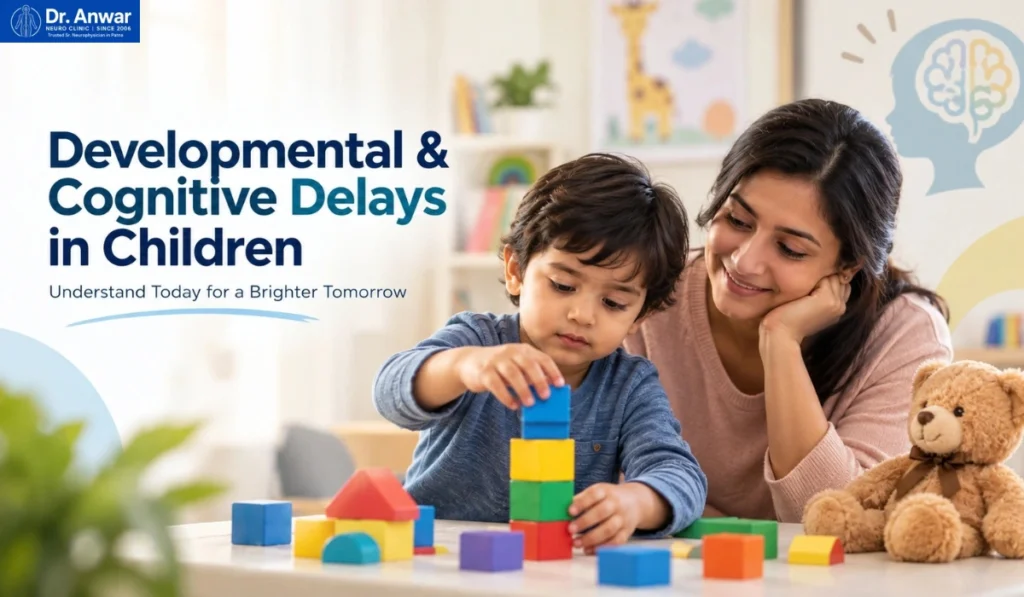
Every child develops at a different pace. One child may start talking early but walk later, while another may be physically active yet need more time to develop language or learning skills. Small differences can be normal.
However, concern becomes more important when a child repeatedly misses expected developmental milestones, has difficulties across several areas, stops progressing, or loses a skill that was previously learned.
Developmental and cognitive delays in children can affect communication, movement, learning, understanding, social interaction, behaviour, and everyday independence. Recognising these difficulties early is not about putting a label on a child. It is about understanding whether further assessment or support is needed.
What Are Developmental and Cognitive Delays?
Developmental delay means that a child is taking longer than expected to develop certain age-appropriate abilities. These may involve speech and communication, sitting and walking, hand coordination, learning, social interaction, play, or self-care.
A cognitive delay in children more specifically affects thinking and learning. A child may have difficulty understanding instructions, remembering familiar tasks, learning new concepts, solving simple age-appropriate problems, or applying previously learned skills.
When significant delays affect multiple areas of development in a young child, clinicians may consider the term global developmental delay. This describes the developmental pattern but does not, by itself, explain the underlying cause.
Read More: Why Do My Legs Feel Heavy While Walking? 7 Neurological Causes to Know
What Early Signs Should Parents Look For?
There is no single symptom that confirms developmental delay. A child’s age, overall progress, and pattern of difficulties are more informative than one isolated milestone.
Speech and Communication Difficulties
Some children may develop speech later than expected, have limited vocabulary, struggle to communicate their needs, or find it difficult to understand simple instructions.
Speech delay alone does not mean autism or intellectual disability. Hearing difficulties, language disorders, developmental conditions, and neurological problems can also affect communication.
Learning and Cognitive Difficulties
Parents may notice that their child needs much more repetition to learn age-appropriate skills, struggles to understand familiar instructions, has difficulty remembering routines, or finds simple problem-solving unusually challenging.
These concerns should always be interpreted according to the child’s age and overall developmental level.
Delayed Movement and Motor Skills
Motor delay can involve sitting, standing, walking, balance, coordination, or using the hands for everyday activities.
Neurological evaluation may be particularly important when motor delay occurs with:
- Unusual muscle stiffness or excessive floppiness
- Persistent weakness
- Frequent falls or poor balance
- Abnormal or involuntary movements
- Difficulty using one side of the body
Social and Behavioural Development
Some children may have difficulty with age-appropriate play, social interaction, communication, or adapting to everyday routines.
One behavioural feature should not be used to diagnose a developmental condition. Social communication, speech, behaviour, learning, sensory responses, and overall development need to be considered together.
Loss of Previously Learned Skills Needs Attention
Developmental delay and developmental regression are different.
A child with developmental delay usually continues acquiring skills, although more slowly than expected. Developmental regression means that a child loses an ability they had already developed.
For example, a child may stop using words they previously spoke, lose motor abilities, become unable to perform familiar tasks, or show a noticeable decline in interaction.
Loss of previously acquired skills deserves timely medical evaluation because certain neurological, genetic, metabolic, and other medical conditions can cause regression.
What Causes Developmental and Cognitive Delays?
There are many possible delayed development causes, and sometimes an exact cause cannot be identified immediately.
Possible causes include:
- Genetic or chromosomal conditions
- Premature birth or low birth weight
- Problems affecting brain development
- Certain infections
- Hearing or vision impairment
- Nutritional or metabolic disorders
- Cerebral palsy or other neurological conditions
- Epilepsy or certain seizure disorders
- Autism spectrum disorder and other neurodevelopmental conditions
The pattern provides important clues. A child who has never developed a particular ability may require a different evaluation from a child who acquired that skill and later lost it.
Developmental difficulties should also not automatically be blamed on parenting. When a genuine concern exists, the priority is identifying the child’s needs and determining whether an underlying condition requires attention.
Does Developmental Delay Mean Autism or Intellectual Disability?
No. Developmental delay is not another name for autism or intellectual disability.
A child may have an isolated speech delay, motor delay, hearing impairment, autism spectrum disorder, global developmental delay, intellectual disability, or another developmental or neurological condition.
For example, delayed speech alone cannot establish autism. Social communication, interaction, behaviour, play, and other developmental features must also be assessed.
Similarly, concerns about a cognitive disorder require age-appropriate evaluation rather than conclusions based on a single delayed milestone.
Also Read: Stroke Symptoms and Treatment: Warning Signs, Causes & Recovery
How Are Developmental and Cognitive Delays Diagnosed?
There is no single test that diagnoses every developmental problem. Assessment usually begins with a detailed developmental and medical history followed by an age-appropriate physical and neurological examination.
A clinician may assess the child’s speech, learning, attention, muscle strength, tone, reflexes, coordination, walking, behaviour, social interaction, hearing, and vision. Pregnancy and birth history, developmental milestones, family history, seizures, unusual movements, and any loss of skills are also important.
Parents can help by bringing medical records, school or therapy reports, and information about when milestones were reached. Videos of unusual movements or episodes may also be useful when they can be recorded safely.
Screening Is Not the Same as Diagnosis
Developmental screening identifies children who may need closer assessment. It does not provide a final diagnosis on its own.
Depending on the concern, further assessment may involve a pediatrician, neurologist, developmental specialist, psychologist, speech and language professional, physiotherapist, occupational therapist, or hearing specialist.
Does Every Child Need MRI, EEG or Genetic Testing?
No. Investigations should be chosen according to the child’s history, symptoms, and clinical findings rather than routinely ordering every test.
Based on what the evaluation shows, additional investigations may include:
- Hearing and vision assessment
- Selected blood or metabolic tests
- Genetic testing
- Brain MRI
- EEG when seizures are suspected
- Formal developmental, cognitive, speech, or behavioural assessment
An EEG may be useful when seizures or certain unusual episodes are suspected, but it is not routinely required for every child with speech delay. Similarly, MRI can provide detailed information about brain structure, but not every developmental concern requires brain imaging.
You May Like: Migraine Treatment: Causes, Symptoms, Triggers & Care
How Are Developmental and Cognitive Delays Treated?
There is no single neurocognitive disorder treatment suitable for every child. Management depends on the child’s difficulties, underlying cause, age, and developmental needs.
Treatment may include speech and language therapy, physiotherapy, occupational therapy, behavioural or developmental intervention, educational support, or treatment of an identified medical condition.
The aim is practical: to improve communication, movement, learning, independence, social participation, and everyday functioning according to the child’s individual abilities.
Why Does Early Intervention Matter?
When a developmental concern is genuine, repeatedly waiting for a child to “catch up” may delay useful support. Early assessment can identify areas in which intervention may help.
Early intervention does not guarantee that every delay will disappear. Progress depends on the cause, severity, developmental areas affected, associated conditions, and individual response.
Parents can also reinforce professionally recommended activities through everyday play, communication, movement, and routines without placing unnecessary pressure on the child.
Read This: Brain Tumour or Stroke? 10 Small Neurological Warning Signs You Should Never Ignore
When Should a Child See a Neurologist?
Neurological assessment may be particularly important when developmental difficulties occur with seizures, significant motor delay, abnormal movements, unusual muscle tone, weakness, coordination problems, or loss of previously learned abilities.
A sudden loss of skills, new weakness, prolonged seizure, loss of consciousness, or another acute neurological change requires urgent medical attention rather than waiting for a routine appointment.
Developmental Neurological Evaluation in Patna
If your child is consistently missing expected milestones, having difficulty with speech, learning or movement, or has lost an ability that was previously established, a detailed assessment can help determine the next steps.
Parents looking for a top neurologist doctor in Patna can consult Dr. Anwar Alam for neurological evaluation of developmental concerns. Further investigations, developmental assessment, therapy, or specialist referral may be recommended according to the child’s clinical findings.
Related Article: What Should I Eat If I Have Epilepsy?
Conclusion
Developmental and cognitive delays can affect speech, movement, learning, social interaction, or several areas at the same time. A delayed milestone alone does not establish a diagnosis.
What matters is the child’s overall developmental pattern, whether progress continues, and whether other concerning symptoms are present. Timely assessment can help identify the child’s specific needs and guide appropriate medical care, therapy, and developmental support.
What Are the First Signs That a Child May Have a Developmental Delay?
Delayed speech, late sitting or walking, difficulty understanding instructions, learning problems, poor coordination, or difficulties with age-appropriate social interaction may be noticed.
Can a child with developmental delay catch up?
Some children make significant progress, while others need ongoing support. Outcomes depend on the cause, severity, areas affected, and response to intervention.
Does Delayed Speech Always Indicate Autism in a Child?
No. Speech delay has many possible causes. Autism assessment considers social communication, behaviour, interaction, and development in addition to speech.
How Do Developmental Delay and Cognitive Delay Differ in Children?
Developmental delay may affect speech, movement, learning, social skills, or everyday activities. Cognitive delay primarily affects learning, understanding, memory, reasoning, attention, and problem-solving.
When Should a Child Be Assessed for Possible Developmental Delay?
There is no need to wait for a particular age when a genuine concern exists. Persistent delays or loss of previously acquired skills should be assessed.
Which doctor should I consult for developmental delay?
A pediatrician is often the first point of assessment. A neurologist may be appropriate when developmental concerns occur with seizures, regression, significant motor delay, weakness, abnormal muscle tone, or unusual movements.