

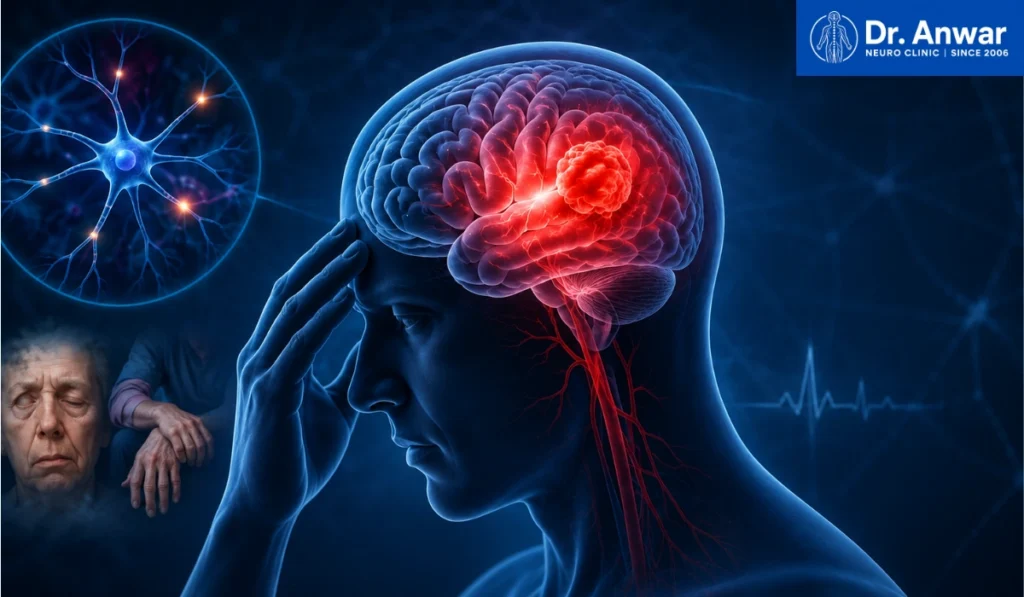
Neurological problems do not always begin with dramatic symptoms. Sometimes the first change is a headache that feels slightly different, an unexplained spell of numbness, difficulty finding the right word, or a tendency to lose balance more often than before.
Because these symptoms can also occur with stress, poor sleep, dehydration, ageing, migraine, or other common health problems, people may continue to ignore them for weeks or months.
The important question is not simply, “Do I have one of these symptoms?” The key is to notice whether the symptom is unfamiliar for you, happens repeatedly, grows more noticeable over time, starts without warning, or appears alongside other changes in how your brain or body is functioning.
A headache does not automatically mean a brain tumour, and occasional forgetfulness does not automatically mean dementia. But certain patterns deserve proper medical attention rather than repeated self-treatment.
Why Can Neurological Problems Start With Small Symptoms?
Different areas of the brain control different functions, including speech, movement, vision, memory, coordination, behaviour, and sensation. A problem affecting one area may therefore produce a very specific symptom rather than making a person feel generally unwell.
Some conditions, such as stroke, often cause symptoms abruptly because blood flow to part of the brain is suddenly interrupted. Other conditions may develop more gradually and cause changes that become noticeable over days, weeks, or longer.
This difference in timing is important. Sudden neurological symptoms may require emergency care, while persistent or progressively worsening symptoms still need evaluation even if they do not feel urgent.
Here are 10 warning signs worth recognising. Part 1 covers the first five.
Read This: Is It Normal Aging or Dementia? Early Warning Signs, Treatment Options and Why Delaying Care Matters
1. A Headache That Feels Different From Your Usual Headache
Headaches are extremely common, and most are not caused by a serious brain disorder. Stress, dehydration, migraine, irregular sleep, screen exposure, skipped meals, and muscle tension can all cause head pain.
What deserves closer attention is a headache that introduces a new pattern.
For example, you may notice that the pain is becoming more frequent, increasingly severe, waking you from sleep, or behaving differently from headaches you have experienced before.
Medical assessment becomes especially important when a changing headache appears with:
- Repeated vomiting
- New weakness or numbness
- Vision changes
- Seizures
- Confusion
- Difficulty speaking
- Increasing problems with balance
A brain tumour is only one possible explanation, and headache alone is usually not enough to identify the cause. The overall symptom pattern and neurological examination matter far more.
2. Sudden Weakness or Numbness on One Side
An arm may occasionally feel numb after sleeping in an awkward position, but sudden weakness or loss of sensation affecting one side of the face or body is different.
If one arm suddenly feels weak, one side of the face begins to droop, or one leg becomes difficult to control, stroke must be considered.
People sometimes wait because the symptoms are painless or begin improving after a few minutes. That can be dangerous. Temporary neurological symptoms may still reflect a transient disruption of blood flow to the brain and require urgent assessment.
Pay particular attention when numbness or weakness appears together with:
- Speech difficulty
- Facial asymmetry
- Sudden visual problems
- Severe imbalance
- Confusion
A sudden change should not be explained away as fatigue, cervical pain, low blood pressure, or “poor circulation” without proper evaluation.
Read More: Is It Just Tingling or Nerve Damage? 5 Symptoms Neurologists Say You Should Never Ignore
3. Difficulty Speaking or Understanding Words
Speech changes can be surprisingly subtle.
A person may know exactly what they want to say but struggle to produce the correct word. Their speech may suddenly become unclear, or they may seem unable to follow a simple conversation they would normally understand.
Gradually developing language difficulties can occur in several neurological conditions, while an abrupt change in speech is particularly concerning for stroke.
Family members should pay attention when someone suddenly:
- Slurs their words
- Uses incorrect or unrelated words
- Cannot name familiar objects
- Has difficulty understanding simple sentences
- Struggles to communicate despite appearing awake
Do not ask the person to “sleep it off” if this begins suddenly. Speech disturbance accompanied by facial weakness, arm weakness, visual change, or balance difficulty needs emergency assessment.
4. New or Unexplained Vision Changes
Temporary blurred vision after hours of screen use is common. Neurological visual symptoms tend to raise more concern when they appear unexpectedly, persist, recur, or occur with other changes.
These may include double vision, loss of part of the visual field, sudden reduction in sight, or difficulty coordinating the eyes normally.
The cause may involve the eye itself, the optic nerve, the brain’s visual pathways, migraine, blood circulation, or another neurological condition.
Seek prompt medical attention when visual disturbance appears suddenly or is accompanied by:
- Weakness or numbness
- Difficulty speaking
- Severe dizziness
- New balance problems
- An unusual headache
- Confusion
The combination of symptoms often provides more useful information than blurred vision alone.
Also Read: Why Do Seizures Happen? Common Causes, Warning Signs, and Treatment Options
5. Memory or Thinking Changes That Begin Affecting Daily Life
Everyone occasionally forgets a name, loses their keys, or walks into a room and forgets why. That by itself is not evidence of dementia or another brain disorder.
The concern increases when thinking or memory changes start interfering with tasks the person previously handled without difficulty.
A family may notice that someone repeatedly asks the same question, forgets recent conversations, struggles to manage medicines or money, gets confused in familiar surroundings, or has increasing difficulty making ordinary decisions.
Changes worth discussing with a doctor include:
- Repeatedly forgetting recent information
- Difficulty concentrating on familiar tasks
- Becoming confused in known places
- Trouble planning or organising ordinary activities
- Increasing difficulty following conversations
- Noticeable decline in judgement
These symptoms can have many possible causes. Dementia is one possibility, but sleep disorders, depression, medicines, vitamin deficiencies, thyroid problems, stroke-related changes, and other neurological conditions can also affect memory.
That is why persistent cognitive change should be investigated rather than automatically being labelled as “normal ageing.”
6. Balance or Coordination Problems That Keep Returning
Feeling slightly unsteady after standing up quickly can happen for many reasons. However, repeated balance problems, unexplained falls, new clumsiness, or difficulty coordinating movements deserve more attention, particularly when they represent a change from your usual ability.
Balance depends on several systems working together, including the brain, inner ear, vision, spinal cord, nerves, and muscles. A problem affecting any of these areas can make walking or movement feel less controlled.
Neurological evaluation may be needed if you notice:
- Frequent unexplained stumbling
- Difficulty walking in a straight line
- New problems coordinating the hands
- Repeated falls without an obvious cause
- Persistent imbalance with weakness or numbness
- Sudden dizziness with speech or vision changes
A sudden loss of balance accompanied by weakness, facial drooping, speech difficulty, or vision loss may be a sign of stroke and requires emergency medical care.
You May Like: Migraine or Normal Headache? How to Understand the Difference
7. Personality, Behaviour, or Judgement Changes
Changes in the brain do not always produce pain or weakness. Sometimes family members first notice that a person’s behaviour has become noticeably different.
Someone who was previously organised may begin making unusual decisions. Another person may become unusually withdrawn, irritable, suspicious, impulsive, or uninterested in activities they once enjoyed.
These changes do not automatically indicate a neurological disorder. Depression, anxiety, medicines, poor sleep, major life events, and other medical problems can also affect behaviour.
The pattern becomes more concerning when personality or judgement changes are persistent, progressively worsening, or occur together with memory, speech, movement, or other neurological symptoms.
Family observations can be particularly valuable because the person experiencing these changes may not recognise how much their behaviour has altered.
8. A First-Time Seizure in an Adult
A seizure does not always involve collapsing and shaking violently. Depending on which area of the brain is affected, a seizure can cause a brief loss of awareness, repetitive movements, unusual sensations, staring, stiffening, or jerking of only one part of the body.
An unexplained first seizure in adulthood needs medical assessment because doctors need to determine why it happened.
Possible causes can include metabolic disturbances, previous brain injury, stroke, infection, structural abnormalities in the brain, or other neurological conditions. In some people, the cause is not immediately apparent.
A seizure may appear as:
- Sudden loss of awareness
- Repeated jerking or stiffening
- A blank stare with no response
- Unusual repetitive movements
- Sudden unexplained confusion
- Strange sensations before awareness changes
One seizure does not automatically mean epilepsy or a brain tumour. However, a first unexplained episode should not simply be ignored because the person appears completely normal afterwards.
Emergency medical attention is particularly important if a seizure continues for more than five minutes, another seizure begins before the person recovers, breathing becomes difficult, a serious injury occurs, or the episode happens during pregnancy.
9. Changes in Walking, Movement, or Tremor
Neurological movement problems may begin gradually enough that patients initially adapt without noticing them.
A family member might notice that someone has started taking shorter steps, walking more slowly, dragging one foot, becoming unusually stiff, or moving one arm less while walking. Others may develop a new tremor or have increasing difficulty starting a movement.
These symptoms can occur for many reasons, including joint or muscle problems, but persistent changes in movement may also involve the brain, spinal cord, or nerves.
Signs worth evaluating include:
- A new or progressively worsening tremor
- Increasing stiffness
- Slower everyday movements
- Dragging a leg or foot
- Reduced arm movement while walking
- Repeated freezing or hesitation when starting to walk
- Increasing difficulty with buttons, writing, or other fine movements
Conditions such as Parkinson’s disease and other movement disorders can develop gradually. An examination helps determine whether the problem is neurological or has another cause.
10. Persistent Changes in Smell, Sleep, or Alertness
A reduced sense of smell is commonly caused by nasal or respiratory problems and, on its own, is not enough to diagnose a neurological disease. However, persistent changes in smell can occur in some neurological conditions, including Parkinson’s disease.
Changes in sleep or alertness also need to be interpreted carefully. Poor sleep, stress, medicines, sleep apnea, depression, and many other conditions can cause excessive tiredness.
Concern increases when a new change in alertness or sleep occurs alongside other neurological symptoms such as movement changes, memory decline, confusion, weakness, or altered behaviour.
Rather than treating these symptoms as proof of a particular disease, doctors consider them as pieces of a larger clinical picture.
When Several Small Symptoms Occur Together
A single symptom often has several possible explanations. The clinical picture becomes more important when multiple neurological changes begin appearing together.
For example:
- Headache with repeated vomiting and new vision problems
- Numbness with weakness on the same side
- Memory decline with personality changes
- Difficulty walking with increasing stiffness or tremor
- Headache with a first-time seizure
- Sudden speech difficulty with facial or arm weakness
These combinations still do not tell you exactly what condition is present. They do, however, provide a stronger reason for medical assessment.
Trying to determine whether symptoms represent a brain tumour, stroke, Parkinson’s disease, dementia, multiple sclerosis, or another condition from an online symptom list can be misleading. Several neurological disorders share similar symptoms, and diagnosis depends on the timing, pattern, examination, medical history, and appropriate investigations.
How Are Neurological Warning Signs Evaluated?

Neurological assessment usually begins with a detailed discussion about what has changed.
The doctor may ask whether the symptom appeared suddenly or gradually, when it started, whether it is becoming worse, which part of the body is affected, and whether other symptoms occur at the same time.
A neurological examination may assess:
- Muscle strength and sensation
- Reflexes
- Walking and balance
- Coordination
- Speech and language
- Eye movements and vision
- Memory and other cognitive functions
Further investigations depend on what the examination suggests.
Blood tests may be useful when vitamin deficiencies, blood sugar abnormalities, thyroid disorders, infections, electrolyte disturbances, or other medical causes are possible.
MRI or CT imaging may be advised when doctors need to investigate the brain or other structures more closely. An EEG may be appropriate for selected patients with suspected seizures.
Not every headache needs an MRI, and not every episode of tingling requires extensive neurological testing. Investigations should be chosen according to the patient’s symptoms and clinical findings.
Stroke Symptoms Require Immediate Emergency Care
Stroke is different from many gradually developing neurological problems because treatment can be extremely time-sensitive.
Remember the warning signs using FAST:
- Face: Watch for a new uneven smile or sudden loss of movement on one side of the face.
- Arm: One arm becomes suddenly weak or numb.
- Speech: Notice any sudden change where words become unclear, sentences no longer come out properly, or the person struggles to communicate as usual.
- Time: Seek emergency medical care immediately.
Other sudden symptoms can include loss of vision, severe imbalance, difficulty walking, confusion, or weakness or numbness affecting one side of the body.
Do not wait to see whether the symptoms disappear. Even symptoms that improve quickly can require urgent medical assessment.
When Should You See a Neurologist?
You should consider neurological evaluation when a symptom is new and unexplained, keeps returning, progressively worsens, or begins affecting normal activities.
An appointment may be appropriate when you develop persistent headaches that have changed in pattern, recurring numbness or weakness, unexplained seizures, progressive memory difficulties, new tremor, persistent balance problems, or changes in speech, vision, behaviour, or walking.
Sudden neurological symptoms are different. Signs suggesting stroke or another acute neurological emergency should be assessed immediately rather than waiting for a routine clinic appointment.
The Bottom Line
Most headaches are not brain tumours. Occasional forgetfulness does not automatically mean dementia, and temporary tingling does not necessarily indicate nerve damage.
What should not be overlooked is a clear change from your normal health, especially when symptoms appear suddenly, persist, progressively worsen, recur without explanation, or begin affecting everyday function.
Neurological conditions can sometimes share similar early symptoms, which is why identifying the cause matters more than trying to match one symptom to one disease.
Early assessment can also reveal conditions that are treatable or manageable before they cause greater difficulty.
Book an Appointment
If you or a family member is experiencing persistent headaches, unexplained weakness or numbness, seizures, memory changes, tremors, balance problems, or other new neurological symptoms, consider a neurological evaluation at Dr. Anwar Neuro Clinic. Patients searching for the experienced neurologist in Patna should prioritise detailed assessment, appropriate testing, an accurate diagnosis, and treatment based on the underlying condition rather than symptoms alone.
Frequently Asked Questions
1. Does a persistent headache mean I have a brain tumour?
No. Headaches have many common causes, including migraine, stress, dehydration, poor sleep, and tension-type headache. A new or progressively changing headache, particularly when accompanied by vomiting, seizures, weakness, or neurological changes, should be evaluated.
2. How can I recognise possible stroke symptoms?
Stroke commonly causes sudden neurological changes such as facial drooping, weakness or numbness on one side, speech difficulty, vision problems, or loss of balance. Those warning signs call for urgent assessment without waiting to see whether they improve on their own.
3. Can a brain tumour cause mild symptoms at first?
Yes. Symptoms depend on the tumour’s location, size, and rate of growth. Some people may initially experience relatively subtle changes involving headaches, seizures, vision, movement, thinking, speech, or behaviour. These symptoms can also have many other causes, so medical evaluation is necessary.
4. Is sudden numbness on one side always a stroke?
No, but sudden one-sided numbness or weakness is an important stroke warning sign, especially when accompanied by facial drooping, speech difficulty, vision changes, or loss of coordination. It should be treated as an emergency until assessed.
5. Should a first seizure in an adult be investigated?
Yes. A first unexplained seizure in adulthood requires medical assessment to determine its possible cause and the likelihood of another seizure. One seizure alone does not necessarily mean epilepsy.
6. Does everyone with neurological symptoms need an MRI?
No. MRI is recommended when the patient’s history and examination indicate that brain or nervous-system imaging may help identify the cause. The appropriate tests depend on the individual symptoms and clinical findings.