
Every toddler develops differently. Some begin speaking early, while others take longer to communicate. But what if your child rarely responds when called, does not point toward interesting objects, or repeatedly plays with toys in the same way?
These behaviours may raise concerns about the early signs of autism, particularly when several developmental differences appear together.
Autism spectrum disorder (ASD) is a neurodevelopmental condition involving differences in social communication and interaction, along with restricted or repetitive behaviours and interests.
Not every delayed milestone indicates autism. Understanding which signs deserve attention can help parents arrange timely developmental assessment and appropriate support.
At What Age Do Early Signs of Autism Appear?
Signs of autism may become noticeable during the first two years, although some children are identified later. Parents should observe how their toddler communicates, interacts, plays, and learns new skills.
- Around 12 months: Limited response to name, few gestures, or reduced participation in simple social games.
- Around 18 months: Rarely pointing to share something interesting, limited social communication, or differences in play.
- Around 24 months: A child may have trouble using words to communicate their needs, engage less in two-way interactions, or repeatedly perform the same actions.
- Between 2 and 3 years: Differences in pretend play, social engagement, sensory responses, or adapting to changes may become clearer.
These are possible concerns, not diagnostic rules. Children develop at different rates, and an assessment considers their overall developmental pattern.
Read More: Developmental and Cognitive Delays in Children: Early Signs, Causes, Diagnosis & Treatment
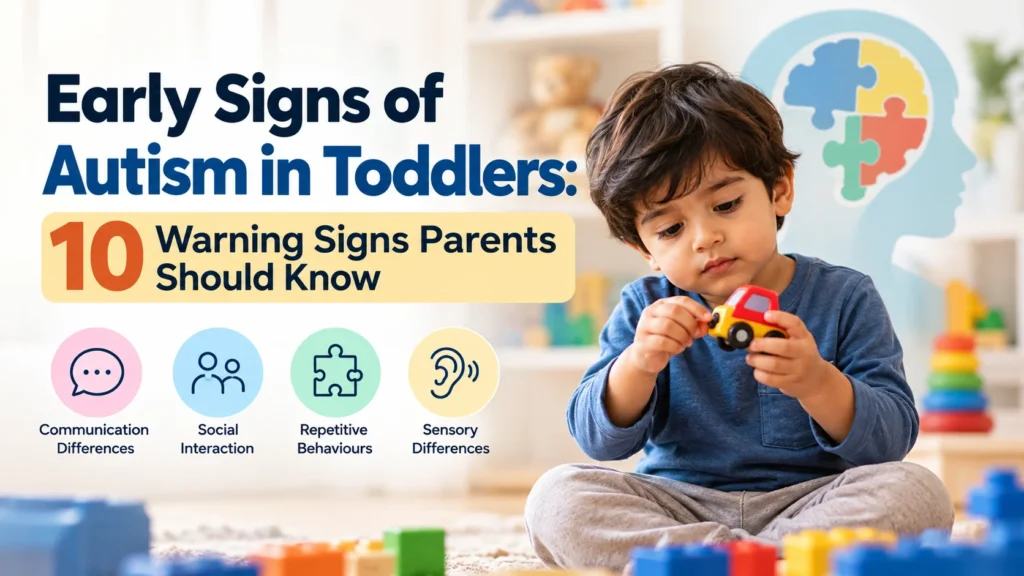
10 Early Signs of Autism in Toddlers That Parents Should Look Out For
1. Your Toddler Rarely Responds to Their Name
When you call your toddler from nearby, do they usually look toward you, turn their head, or acknowledge you?
Some autistic toddlers may not consistently acknowledge being called, even in a quiet environment with minimal distractions. However, hearing difficulties can produce similar concerns.
If your child repeatedly does not respond to their name, a developmental and hearing assessment may help identify the reason.
2. Limited Eye Contact During Interaction
Some toddlers use eye contact less frequently when communicating or sharing an experience.
For example, a child may look at a favourite toy but rarely look back toward a parent to share their excitement.
Eye contact varies between children. A toddler who makes eye contact can still be autistic, while limited eye contact alone does not establish autism.
3. Delayed Speech or Difficulty Communicating
A toddler may use fewer words than expected or struggle to communicate everyday needs.
However, spoken words are just one of the many ways children express themselves and interact with others. Gestures, facial expressions, pointing, and attempts to share attention also matter.
For example, a child who cannot say “water” but points toward a glass and looks at a parent is communicating differently from a child who rarely uses words or gestures.
Speech delay alone does not confirm autism. Hearing difficulties and language disorders must also be considered.
4. Rarely Points to Show Something Interesting
Imagine your toddler noticing an aeroplane overhead. They may point toward it and look back at you, inviting you to notice it too.
This process of directing another person’s attention toward the same object or event is known as joint attention.
Some autistic toddlers may use pointing to ask for something they want but seldom use it to draw another person’s attention to something they find interesting.
Persistent differences in joint attention can be an important developmental concern.
5. Limited Back-and-Forth Social Interaction
As children grow, they begin communicating with others through shared smiles, simple gestures, different sounds, and playful interactions.
For instance, a toddler might smile, make a sound, or move excitedly in response when a parent makes a playful noise and waits for their reaction.
Some autistic children may respond to these social interactions in different ways or show less interest in starting them.
Occasionally preferring independent play is normal. Healthcare professionals assess whether these differences in social interaction occur consistently during a child’s daily activities.
6. Limited Imitation or Pretend Play
Toddlers often learn by copying familiar activities, such as brushing a doll’s hair or pretending to speak on a toy phone.
Some autistic toddlers develop imitation and pretend-play skills differently or prefer repeatedly exploring particular objects.
Play expectations depend on age. Limited pretend play in a very young child does not independently indicate autism.
7. Repetitive Movements or Play Patterns
Some toddlers repeatedly perform particular movements or activities.
Examples include:
- Frequent hand flapping or body rocking
- Spinning wheels or other objects repeatedly
- Arranging toys in the same sequence
- Focusing intensely on one part of a toy
Repetition is also common in typical childhood play. Its significance depends on persistence, intensity, and whether other developmental differences are present.
8. Strong Difficulty With Changes in Routine
Does your toddler become unusually distressed when a familiar route changes, an activity ends, or toys are moved?
Some autistic children have a strong preference for predictable routines and find transitions particularly difficult.
However, many toddlers struggle with changes. Concern increases when these difficulties are persistent, significantly affect daily activities, and occur alongside other autism-related signs.
9. Unusual Responses to Sounds, Touch, or Textures
Some autistic toddlers respond strongly to everyday sensory experiences.
For example, a child may cover their ears when a mixer runs, avoid particular clothing textures, or become unusually interested in moving lights.
Others may show reduced responses to certain sensations.
Sensory responses alone are not enough to confirm autism, but they can offer important clues when evaluating a child’s overall development.
10. Loss of Words or Skills Previously Learned
A toddler who previously used meaningful words may stop speaking them. Another child may lose familiar gestures or become noticeably less socially responsive.
This is called developmental regression.
Regression does not always indicate autism. Certain neurological, genetic, and other medical conditions can also cause loss of acquired abilities.
If your child loses previously learned language, social, or movement skills, seek prompt medical assessment. Sudden weakness, altered consciousness, or prolonged seizures require emergency care.
Also Read: Why Do My Legs Feel Heavy While Walking? 7 Neurological Causes to Know
Does Delayed Speech Always Indicate Autism in Children?
No. A toddler can have speech delay without having autism.
A child with an isolated language delay may use fewer spoken words but continue pointing, sharing interests, responding socially, and participating in age-appropriate play.
Autism involves a broader pattern of social communication differences together with restricted or repetitive behaviours.
Parents cannot reliably distinguish these conditions through a single symptom. Developmental and hearing assessments help identify the child’s needs.
How Is Autism Diagnosed in Toddlers?
Autism is diagnosed through developmental history, behavioural observation, and clinical assessment. No routine blood test, MRI, or EEG independently confirms autism.
An assessment may include:
- Reviewing developmental milestones and parental observations
- Evaluating communication, interaction, and play
- Assessing repetitive behaviours and sensory differences
- Checking hearing, speech, and other developmental abilities
- Identifying coexisting neurological or developmental conditions
The M-CHAT-R/F is a screening questionnaire designed for children aged 16-30 months. This screening tool helps identify toddlers who may require a more detailed developmental assessment, but its results alone cannot confirm a diagnosis.
Healthcare professionals recommend screening children for autism at both 18 and 24 months of age. However, concerns should be assessed whenever they arise.
You May Like: Stroke Symptoms and Treatment: Warning Signs, Causes & Recovery
What Steps Should Parents Take If They Recognise These Warning Signs?
Observe your child’s communication, play, gestures, and interactions in familiar situations. Note specific concerns rather than relying on an online symptom checklist.
Discuss them with your pediatrician. Based on the child’s assessment results, the doctor may suggest a hearing test, developmental screening, or a more detailed examination by a specialist.
Parents do not always need to wait for a confirmed autism diagnosis before beginning appropriate support for an identified developmental difficulty.
Can Autism Be Cured? What Treatment Helps?
Autism is a lifelong neurodevelopmental condition. There is currently no established cure, but individualized support can help children develop communication, learning, and everyday living skills.
Autism treatment may involve speech and language therapy, occupational therapy, developmental or behavioural interventions, educational support, and caregiver guidance.
For example, speech therapy may support functional communication, while occupational therapy may help with daily activities or sensory-related difficulties.
Medication does not cure autism. It may sometimes be prescribed for specific coexisting medical or behavioural concerns.
Progress varies between children. The goal is to help each child build essential skills, participate in everyday activities, become more independent, and improve their quality of life without guaranteeing specific results.
Read This: Migraine Treatment: Causes, Symptoms, Triggers & Care
When Should Parents Seek an Autism Assessment in Patna?
If your toddler consistently struggles with social communication, play, or behaviour, or begins losing skills they had already developed, a detailed medical evaluation can help identify the underlying concerns and guide appropriate care.
Families seeking an autism specialist in Patna can consult Dr. Anwar Neuro Clinic provides neurological assessments for children with developmental concerns and offers guidance on additional testing, suitable therapies, and referrals to other specialists when needed.
Learn more about Autism Spectrum Disorder Treatment in Patna.
Conclusion
The early signs of autism in toddlers may involve differences in communication, social interaction, play, repetitive behaviours, or sensory responses. These signs vary from child to child, and no single behaviour can confirm autism. If developmental concerns persist, parents looking for a senior neurologist doctor in Patna can seek a professional neurological evaluation to better understand their child’s developmental needs and explore appropriate care and support options.
Frequently Asked Questions
What Are the Earliest Signs of Autism in a 1-Year-Old?
Early warning signs may include using fewer gestures than expected, rarely responding when called by name, and showing limited interest in sharing experiences with others. These observations require assessment in the context of the child’s age and overall development.
What Are Common Autism Symptoms in a 2-Year-Old?
Possible symptoms include differences in social communication, limited gestures, delayed language, repetitive behaviours, sensory sensitivities, or difficulty adapting to changes. No single symptom confirms autism.
Can a Toddler Have Autism Even With Good Eye Contact?
Yes. Some autistic toddlers make frequent eye contact. Diagnosis depends on broader developmental and behavioural patterns rather than eye contact alone.
Can Autism Be Diagnosed Before Age 3?
Yes. Qualified healthcare professionals can often accurately diagnose autism in children as young as two years old. Some children require continued monitoring or further assessment.
Does Every Child With Speech Delay Need Autism Testing?
Not necessarily. Persistent speech delay warrants developmental and hearing assessment. A detailed autism assessment may be recommended if a child also shows difficulties with social interaction, communication, or unusual patterns of behaviour.
Which Specialist Should Parents Consult for Suspected Autism?
Parents who suspect developmental concerns in their child can begin by consulting a pediatrician for an initial evaluation. Further evaluation may involve a developmental pediatrician, child neurologist, psychologist, speech-language professional, or multidisciplinary team.